
THE ZANSHIN KIRI PRINCIPLE
(for film editors)
The film cut (and the cut in general) is the point where movement pivots, not where it stops. The cut does not arrest movement but redirects it through a pivot. Every movement begins within the preceding shot or sequence and ends within the following one.
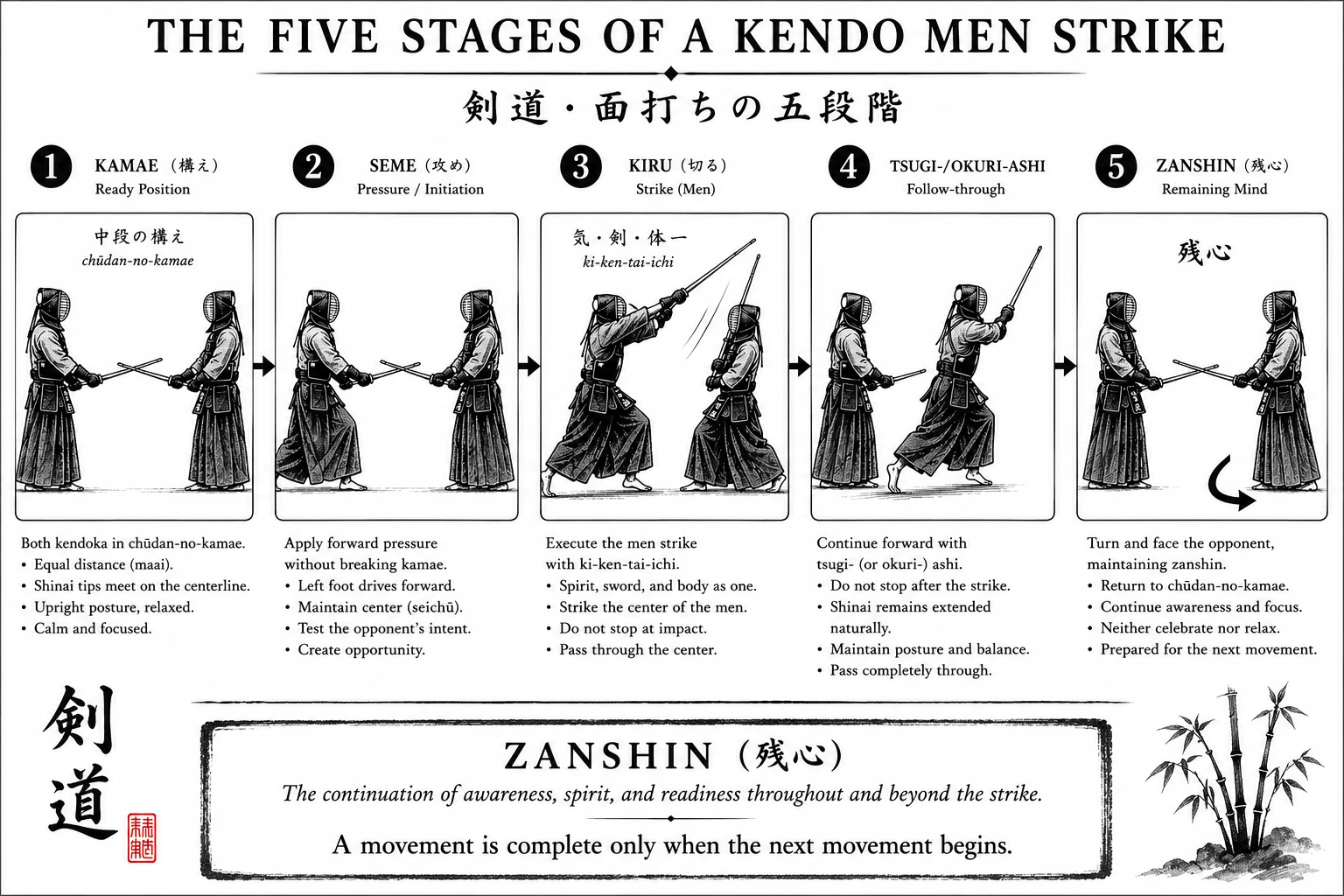
This is the same principle as the cut in Kendo, the Japanese art of swordsmanship. The cut (kiri) is not the end of the movement but its midpoint—the moment of moving through the opponent. The movement ends only after the power of the cut, the pivot, reaches its natural conclusion. The practitioner (kendoka) does not think of the cut as an act of slicing, but as part of moving through. Every technique consists of a beginning, a midpoint (the cut/pivot), and a finish (zanshin).
Zanshin translates as a “remaining mind.” Zanshin is the awareness of the kendoka's position after the cut and the readiness to cut again. The movement, thus, ends only when the kendoka is once again facing the opponent, prepared to move through them. The end of one technique is therefore simultaneously the beginning of the next.
The principles of the cut in Japanese swordsmanship and film editing are structurally identical. In neither does the cut exist as an isolated event. It is always the pivot of a continuous movement.
Every cut has its aftermath: a balancing movement that brings it to rest and readiness. Every human movement and action has its point of cut. The cut is therefore not an event but a principle— a pivot through which movement continues.
Applied to film editing, the Zanshin Kiri Principle fosters presence by preserving the viewer's awareness of uninterrupted movement, revealing (or disguising) the cut not as a break, but as the pivot of continuity.
Connect for more on the technique, classes and demonstrations of the Zanshin Kiri Principle for film editors.